A guest stands by the pool, looking for the mountains. On Instagram, they were right there, glowing in the evening light. In reality, the view is of the parking lot. The image was too good to be true, because it came from an AI tool.
Since August 2, 2026, it should have been labeled. Instagram now limits the reach of unlabeled AI profiles, and the EU AI Act requires transparency for realistic AI images of real places. Here’s what that means for your channels and how to use AI without losing your guests’ trust.
Key takeaways
- Article 50 of the EU AI Act has applied since August 2, 2026: realistic AI images, video and audio of real people, places or events must be labeled.
- On August 31, 2026, Instagram replaced its “AI Creator” profile label with “AI-generated profile.” Unlabeled AI profiles lose reach.
- For most brands, the “AI info” label on individual posts matters more.
- Using AI for ideas, captions and standard photo editing doesn’t require a label.
- Violations can lead to fines of up to €15 million or 3% of worldwide annual turnover.
What Instagram changed in 2026
In May 2026, Instagram tested a voluntary profile label called “AI Creator.” On August 31, a stricter version followed. The label is now called “AI-generated profile” and applies to profiles that feature an AI-generated person. Profiles that don’t use it risk lower reach and may be dropped from recommendations (Instagram’s announcement).
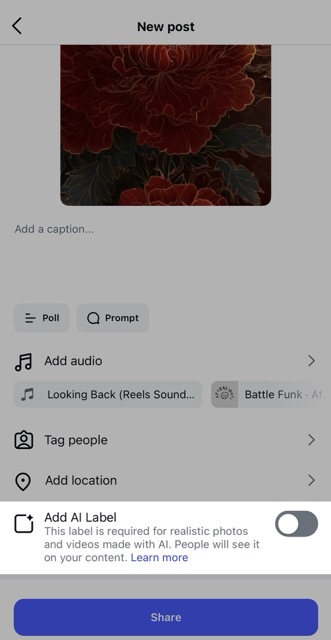
For most brands, the profile label isn’t relevant: according to Instagram, using AI for captions, photo editing or graphics doesn’t require it. What matters more is the “AI info” label on individual posts. You can add it yourself when posting, but Meta also applies it automatically when its systems detect AI editing.
What the EU AI Act requires
Instagram’s labels reflect rules that already apply across the EU, on every channel. Article 50 of the EU AI Act has applied since August 2, 2026. For social media teams, two obligations stand out.
- Chatbots, for example in your DMs, must be identifiable as AI.
- Deepfakes must be labeled. These are images, videos or audio created or altered with AI that closely resemble real people, places or events.
The label must be clear and visible, appear no later than the first time someone sees the content, and be accessible. Small print is not enough. Text doesn’t need a label just because AI helped write it. The exception is text on matters of public interest that is published without human review.
Why this matters for tourism
For tourism brands, the part about places is key. In our view, a realistic AI image of your hotel, park or region falls under this rule. Clearly artistic, fictional or satirical content is subject to lighter requirements.
The technical obligation to add machine-readable markings mainly applies to AI tool providers. For systems already on the market, the deadline is December 2, 2026. All other Article 50 obligations already apply with no transition period.
maximum fine for violating Article 50 (3% of worldwide annual turnover; the lower amount applies to SMEs)
Article 50 of the EU AI Act applies
deadline for technical marking by AI tools already on the market
Fines and enforcement
Violations of Article 50 can lead to fines of up to €15 million or 3% of worldwide annual turnover, and for small and medium-sized businesses the lower amount applies. Enforcement lies with national market surveillance authorities.
The European Commission’s voluntary code of practice on marking and labeling AI-generated content helps with implementation. This article is not legal advice. For borderline cases, a legal review is worth it.
What applies on other channels
The EU AI Act applies to every channel, including Facebook, TikTok, YouTube, LinkedIn and your website. Platform labels, however, differ. In short: what works for Instagram doesn’t replace a check for your other channels.
| Channel | How the AI label works |
|---|---|
| Instagram and Facebook | Meta reads the provenance data in files from major AI tools and automatically applies the “AI info” label. You can also add it yourself when posting. |
| TikTok | AI label required for content that is fully AI-generated or significantly edited, but not for minor touch-ups or AI used as a writing aid. |
| YouTube | YouTube Studio offers an “altered or synthetic content” setting for videos, Shorts and livestreams that depict real places, events or people in a misleading way. |
As of October 2026. Platform rules may change.
Why authenticity matters especially in tourism
Guests book a promise. When they see a room, a beach or an attraction on Instagram, that’s exactly what they expect when they arrive. If reality falls short, the disappointment shows up in reviews and comments.
Performance matters too. In Metricool’s “State of AI in Social Media 2026” study, 14% of the social media professionals surveyed say AI content performs worse than non-AI content, up from 5% a year earlier. AI is no guarantee of reach. Real insights from staff, guests and creators remain the foundation of a credible presence. For more on this year’s platform changes, read Instagram 2026: what’s changed and what it means for your marketing.
of social media professionals say AI content performs worse (2026)
said the same a year earlier (2025)
Where AI makes sense and where you should label
The line is what the image, video or audio shows. As long as AI helps behind the scenes or with standard editing, you usually don’t need a label. Once it changes what viewers take to be real, you do.
Usually fine without a label
- Ideas, content planning and editorial calendars
- Captions, hashtags, subtitles and translations you review before posting
- Suggested replies to comments and DMs that a person reviews and sends
- Analyses, reports and reviews of your insights
- Standard photo editing such as lighting, color, cropping or sharpness
- Minor touch-ups that don't change what the image shows, like a speck of dust or a cable in the background
- Graphics, icons, backgrounds or clearly drawn illustrations that don't depict a real place or a real person
Label it, or better yet, skip it
- Realistic AI images of your property, rooms or region
- Edits that visibly change amenities, size or surroundings
- AI-generated people who look real, such as guests, families or models
- Real people whose face, body or appearance has been altered with AI
- AI voices or voiceovers that sound like real people
- Realistic AI videos, such as drone flights or scenes that were never filmed
- Events or situations that never happened, such as a packed festival or a snow-covered park
- AI avatars as the face of your brand
- Fake guests or reviews: skip these entirely
Good to know
TikTok is stricter than Meta. There, fully AI-generated content needs a label even if it doesn’t look realistic. And touch-ups have limits: if you remove a construction site, crowded loungers or bad weather, you change what the image says. That content belongs in the “label it” category.
Checklist for your channels
- Set an internal AI policy: which tools, for what, and who approves.
- Check every post before publishing. Does it show people, places or events that were created or realistically altered with AI? Does it use an AI voice? Then turn on the channel's AI label and mention it in the caption.
- Only alter real people, such as guests or staff, with their consent.
- Label AI content beyond social media too, for example on your website or in ads.
- Label chatbots in your DMs as AI.
- Add clear AI rules, including labeling, to your creator and influencer briefs.
- Keep track of which content was created with which AI tool, so you can respond quickly to questions.
- Build real content into your calendar, such as behind-the-scenes looks and posts from your guests.
- Use your insights to compare how AI-assisted and real posts perform.
Who this applies to
The new rules affect marketing managers at hotels, vacation parks, amusement parks and destinations, as well as owners who run their own channels. If you promote your business in the EU on social media or your website and use AI, it’s time to review your processes.
How Red can help
Our Social Organic team works with tourism and leisure brands in Germany, the Netherlands, France and Belgium. Together with you, we develop content strategies, AI guidelines for your team and creator partnerships that show real experiences.
Want to know where your social media channels stand on AI? Get in touch and we’ll review your content together.
Frequently asked questions
No. The labeling obligation covers images, video and audio created or altered with AI that closely resemble real people, places or events. Using AI for ideas, captions or standard photo editing usually doesn’t require a label. Chatbots, however, must be identifiable as AI.
Only if your profile features an AI-generated person. According to Instagram, using AI for captions, photo editing or graphics doesn’t require it. For individual posts with realistic AI images, use the “AI info” label.
On Instagram, unlabeled AI profiles may see lower reach and be dropped from recommendations. Under the EU AI Act, violating Article 50 can lead to fines of up to €15 million or 3% of worldwide annual turnover. For SMEs, the lower amount applies.
Always turn on the channel’s AI label and add a short note in the caption as well. The label must be clearly visible the first time someone sees the content. A note hidden in small print is not enough.