In the past week, more and more Google users in the Netherlands have seen AI overviews in the search results (SERP). This is currently still a test phase, but it won’t be long before all users will see the feature. AI overviews are quite a change in the search landscape. In this blog, we want to tell you more about how this will affect your organic results and what you can do yourself.
What are AI overviews?
Back up a moment, because what exactly are AI overviews (AIO)? AI overviews are automatic summaries that Google displays at the top of search results and that are generated directly by artificial intelligence. They are designed to give users quick and immediate answers to their search queries without them having to click on a link or leave Google. This reduces the original organic search results and users receive faster answers to their search queries. Of course, this also applies to adverts in Google Ads.
An AI overview is often a section of text enriched with links, lists or references that Google’s AI model (Gemini) has compiled based on information from multiple sources on the web. It is therefore possible to view the sources and still end up on a website.
If we look at the countries where AI overviews have already been fully introduced, but also the Netherlands, we see that AI overviews are mainly visible for informative search intentions, instructions and comparison queries. However, we also see that they appear in the orientation phase, which we refer to as the ‘dream phase’.
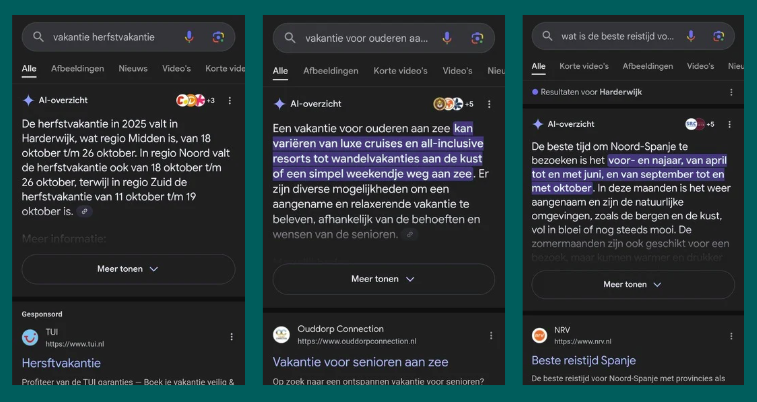
Here are some examples from the travel industry. AI overviews on ‘autumn holidays’, ‘holidays for older people by the sea’ and ‘what is the best time to travel to northern Spain’.
What influence do AI overviews have on organic traffic?
As the test phase in the Netherlands has only just started, we cannot yet say exactly what the impact will be in our country. However, if we look at information from countries where AI Overviews have already been in place for some time, we see, for example, that Ahrefs already indicates that AI Overviews clicks have decreased by almost 35% (source: Ahrefs). Similarly, both SEO and PPC CTRs (click through rates) are currently said to be lower than ever before (source: Seerinteractive). This is because people are more likely to stay on Google because they have already found their answer there, making a click unnecessary.
What can you generally expect for your organic traffic?
- A decrease in the number of clicks on your organic search results, which leads to a significantly lower click-through rate (CTR). But: on the contrary, an increase in impressions due to inclusion in the AI overviews.
- Change in usage from short and concise search queries to more detailed search queries (long-tail) with more context and sometimes even local.
- The biggest drop in clicks is for search terms of an informative nature, e.g. ‘How does…’, ‘What is…’ or ‘Tips for…’.
- The visitors who click through to your website are generally more valuable: they have clicked deliberately despite the AI answers and are therefore often more motivated or further along in their search.
How do you adapt your SEO strategy to AI overviews?
One thing should be clear: AI overviews are here to stay. But how do you deal with SEO and the growth and monitoring of your organic traffic with the advent of AI overviews?
The most important thing is to be visible in AI overviews. Even if the number of clicks decreases because users often get the answer immediately, they can still click through to your website if Google lists it as a source. At the same time, your impressions will increase significantly if you are included in the AI overviews (source: BrightEdge).
As a result, the focus of monitoring your organic traffic will increasingly be on comparing impressions rather than clicks and CTR.
How do you become visible in AI Overviews?
The basic principles for success in search results haven’t really changed. Basically, the same efforts would also contribute to your visibility in the AI overviews. This means that your content should be really helpful and useful for the user, and you should adhere to the E-E-A-T principles. There is absolutely no room for classic SEO texts without added value.
However, it is advisable to look at optimisation specifically for AI overviews, as is possible for inclusion in AI chatbots such as ChatGPT. Examples include writing like humans speak, optimising for long-tail keywords and using structured data and lists. Find out more in our blog ‘Ranking in AI’.
What else can you do?
In addition to optimising for AI overviews and AI chatbots, it is important that you think more omnichannel. Customise your content and distribute it on multiple channels such as social media. Make sure you are truly visible as an authority in your niche. We have already written about social search in our BrightonSEO blog.
The inaccuracy of AI overviews
The AI overviews were not well received in other countries, and mostly people tried to get rid of them with tricks (source: Tom’s Guide). This is mainly due to the display of false results. Google has taken measures to prevent this, but it is impossible to eliminate it completely (source: NOS).
So what is happening?
An article by NOS explains that the AI overviews can, for example, formulate a completely different (wrong) answer with a different source in a short interval. This also happens in medical research, which in turn raises questions about the ethics of AI overviews; after all, what happens when people accept falsehoods? In any case, it is to be feared that the quality of the search results will decrease.
Let’s move on: AI mode
Google is also expanding its AI mode. Here you can ask questions and receive comprehensive, contextualised answers with the option to ask more questions and view additional resources.
Help! Not sure what the AI overviews mean for you, or your organic results are suddenly dropping very quickly? Get in touch with us, we’d love to take a look!