We have already written in a previous article about how you can rank in AI Overviews lists. But AI doesn’t just affect your SEO traffic, it also changes SEA at lightning speed and in the short term. Do you see a drop in clicks or impressions? Do you have the feeling that you are losing visibility? In this blog, we explain what AI Overviews mean for your Google Ads structure and, above all, what you can do now to be prepared for the coming developments.
What are the AI Overviews about again?
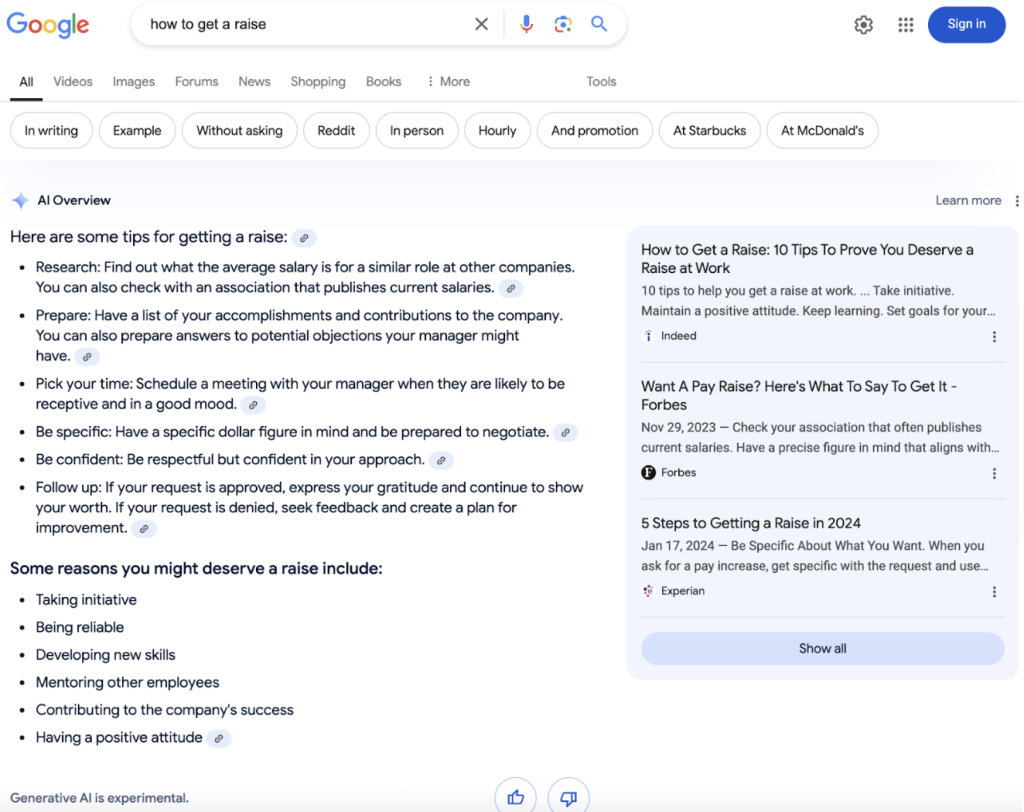
Google’s AI Overviews directly answer the search query without you having to click. Imagine you are searching for:
‘Which zoo in Belgium is nice for small children?’
Then you will no longer just get a list of SEO results or adverts. Instead, Google may show you an AI-generated answer. For example, with tips such as: ‘Pairi Daiza is great for small children because of the many playgrounds and the petting zoo’, including links to some resources.
Sounds practical for the user. But for you as an advertiser? Pretty sobering. Because your advert, which used to be at the top, is now sometimes only displayed below the AI box – or not at all.
What will change for you as an advertiser?
1. Your visibility for informative search queries decreases
Campaigns that target more general search terms such as ‘child-friendly holidays in the Netherlands’ or ‘beautiful natural landscapes in France’ are more likely to encounter AI overviews. The result: your advert will slide down the rankings – or won’t be displayed at all.
If you look at the 5 phases of the journey we use, you will notice this effect particularly in the dream and planning phase (where inspiration and orientation take centre stage). You can expect a decline in impressions and clicks there in future.
This will have an indirect impact on bookings: You are more likely to miss a touchpoint – and therefore less likely to be considered. You will also lose valuable website traffic, which will reduce your remarketing lists.
2. Performance Max and automation will become even more important
As AI overviews are primarily replacing text-based search results, it will become even more important to be visible where you reach people earlier in their journey: for example on YouTube, in Google Discover, in the display network or via Gmail.
Performance Max does this for you automatically. However, you need to make sure that you deliver the right content – i.e. high-quality images, videos, target group signals and clear campaign objectives.
We have already written a blog about this and can tell you: Google sees Performance Max as the central advertising product for the near future, especially in order to be able to react appropriately to the changes in the online marketing world.
3. Google is testing adverts within AI Overviews
And this is something you should keep an eye on. Google is already testing adverts that are placed directly in the AI responses – for example, as a carousel under an AI summary or as a highlight within the text.
This is still very limited in terms of visibility, but it could develop into a whole new auction space. We haven’t seen such formats in the Netherlands yet, but as long as there is potential for monetisation there, it is very likely that these advertising spaces will be auctioned in the future.
So, like us, keep a close eye on this.
What do you see happening?
- Fewer clicks on search terms that are not related to your brand
- Lower CTR for informative search queries
- More traffic via YouTube or display – provided your campaigns are set up well
- And sometimes: an increase in brand traffic because the AI steers the user in the direction of your brand after all
But the latter doesn’t happen by itself. You have to do something about it.
What can you already do in the area of advertising?
✅ Become more visible for search queries to which AI cannot provide good answers
AI overviews are strong for general queries, but (still) less effective for
- Specific offers (e.g. ‘holiday park with discount June 2025’)
- Current information (e.g. ‘Last minute child-friendly hotel Ardennes’)
- Unique offers (e.g. ‘Single parent holidays with entertainment’)
✅ Use your own data cleverly
You will receive fewer random clicks – so existing contacts become more valuable Build target groups via:
- Customer lists
- Website visitors (with intelligent segmentation)
- Newsletter subscribers
And use them in your campaigns so that you feed the AI with the right signals. This is particularly important in times when more and more data is being lost.
✅ Work on your brand and give branding a bigger (or any) share of the budget
If Google delivers the answer directly and there are fewer clicks, you need to make sure your brand stays in people’s minds. Therefore work on:
- Visibility via YouTube & Display
- Campaigns for consideration and inspiration
- Clear visuals and videos that create recognition
Conclusion:
Continue to invest in SEA – specifically where AI is less present. Check for yourself what search results look like by carrying out your own search queries. Use bidding strategies and keywords smarter (focus on purchase-oriented terms), combine Performance Max with search campaigns for more control – and optimise where necessary.
Summary
AI overviews are changing the playing field. Where you used to be able to rely on keywords and clicks, you now have to think more in terms of user intent, brand preference and full-funnel campaigns.
For many travel and leisure brands, this means
- Less free visibility
- Less easy ways to reach new customers
- More need to set everything up cleanly and strategically
But: Those who react now – with cleverly built performance-max structures, strong content and a recognisable brand story – will benefit later (and may already feel the success now).
Are you unsure how your campaigns are positioned in an AI-dominated world?
Or would you like to discuss how to use Performance Max effectively along the customer journey?
Then get in touch with us – we’ll be happy to take a look together.